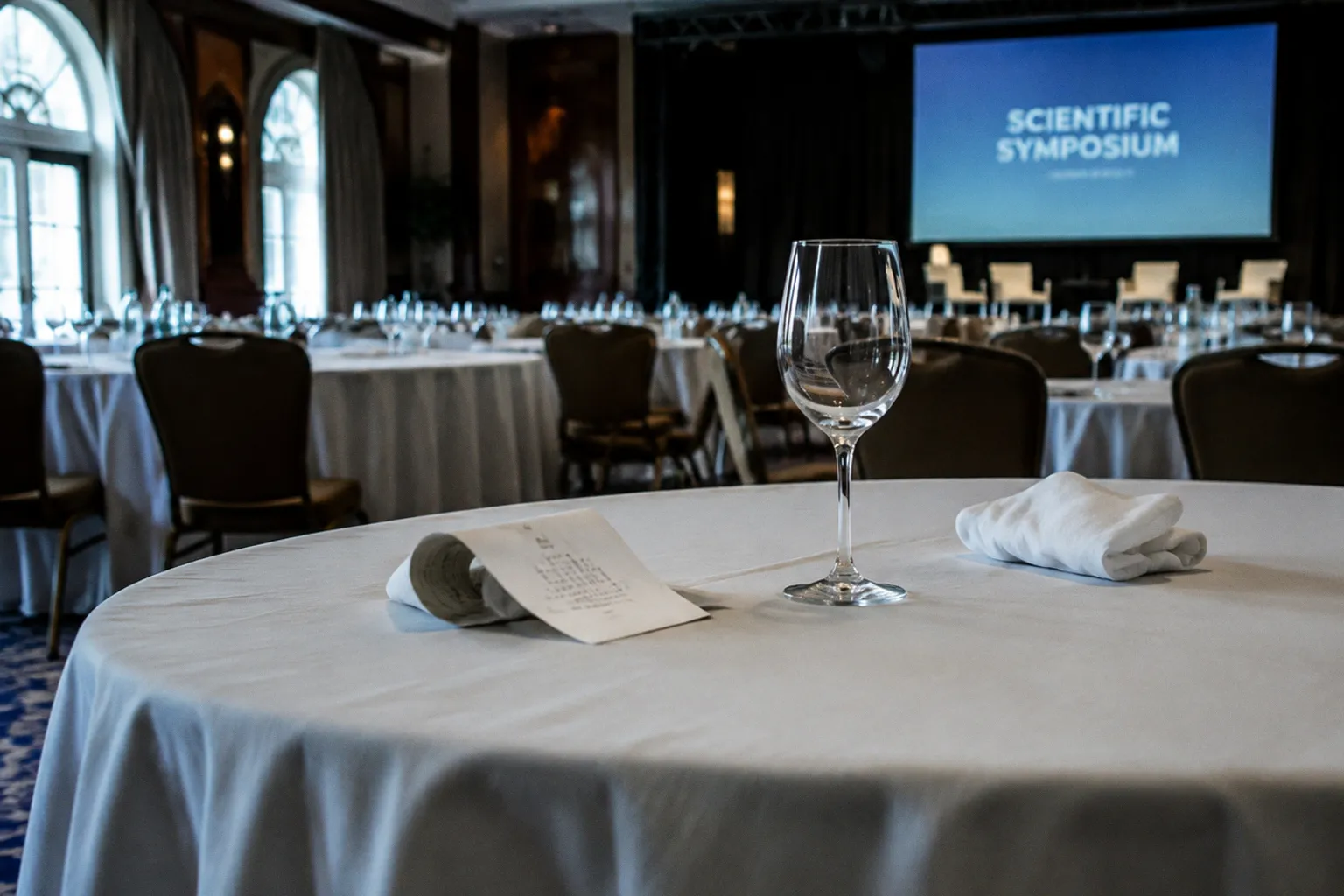
The number every medical affairs team whispers about is £75. It's quoted in compliance training decks; cited in slide after slide; and routinely — disastrously — misread as a comfortable ceiling for dinner with a key opinion leader after a long advisory board session. The number everyone misremembers, the one that actually matters, is that £75 isn't a routine threshold at all. Under Clause 10.8 of the ABPI Code of Practice, administered by the PMCPA, it is the absolute maximum a company may spend on subsistence per delegate, and only in genuinely exceptional circumstances. Everything below that line is supposed to be modest; secondary to the science; and — most importantly — defensible to a panel that has seen every justification an over-eager brand team could possibly invent.
I have read more breach cases than I would like to admit. The pattern is depressingly consistent. The educational content is robust. The faculty is credible. The agenda runs to time. Then someone books a venue with a Michelin star and forgets that it is optics, not intent, that decides these things. What follows is how the PMCPA actually reads hospitality breaches — and where well-meaning teams consistently trip the wire.
The £75 subsistence cap is not a benchmark to aim for; it is a ceiling to avoid hitting.
The Primacy of Educational Purpose: Defining Secondary Hospitality
Strip the ABPI hospitality rules down to their bones and you find a single test: is the hospitality strictly secondary to the main educational or scientific purpose of the meeting? That word — secondary — does most of the heavy lifting. It is also the word brand teams most often try to argue around.
The structure of a typical breach reads almost identically: a well-known faculty list, a credible agenda, a meeting that on paper looks entirely defensible. The hospitality layer underneath it — the venue, the food, the overnight stays, the off-program dinner — quietly inflates the meeting into something that is no longer about education at all, but about entertaining a group of high-prescribing clinicians. The PMCPA has been unsentimental about this. Where the educational content is thin, the hospitality cannot rescue it. Where the hospitality is lavish, the educational content is presumed to be a stage set.
Here is the test I now apply before signing off any meeting logistics: if you stripped the talks, the slides, the faculty, and the CME accreditation, would the meeting still exist in the form you have booked it in? If the answer is "yes, it would still be a very nice dinner in a very nice hotel," you have your answer. The Code is unambiguous — hospitality must be secondary, and the burden of proof sits squarely with the company, not with the panel.
The second test is one of proportionality. A two-hour advisory board with two external consultants does not need an overnight stay, a four-course dinner, and a wine list curated by a sommelier. The Code does not prohibit comfort, but it does prohibit excess, and the panel has historically been reluctant to accept "this is what the venue offered" as a defence. The argument that the venue package forced a certain standard of hospitality does not survive contact with the panel — the venue is a choice, and choices are evaluated. Inside the company's own echo chamber, the rationale sounds entirely reasonable; outside it, the panel reads the meeting as a whole and reaches a very different conclusion.
Decoding the £75 Subsistence Threshold and Exceptional Circumstances
Clause 10.8 is short, sharp, and routinely abused. The current text — and its predecessor, Clause 22.2 — sets the maximum cost of a meal provided as subsistence at £75 per person, excluding VAT and gratuities. That figure is the upper limit, not the working assumption. PMCPA case law has repeatedly framed it as a cap reserved for exceptional circumstances, and a standard routine business lunch should land well below it.
What this means in practice is that a sandwich lunch in a meeting room is presumed compliant by default. A hot lunch at a venue hotel with coffee service is presumed compliant if the per-head cost is documented and proportionate. A tasting menu with paired wines at a venue with a chef's name above the door is, almost irrespective of the price, a different conversation — and that conversation is one a medical signatory should not be having over email.
The pattern in PMCPA rulings on subsistence is consistent: the panel looks at the receipt, not the rationale. A company that books a high-end restaurant because it is the only place near the venue with availability will be judged on the per-head cost that restaurant charges, not on the operational inconvenience of finding somewhere cheaper. There is no "we had no choice" defence under the Code. There is only the question of whether the cost was proportionate, defensible, and — to use a word the panel tends to favour — appropriate.
I have seen teams try to route around this with creative invoicing — splitting the bill, using a different cost code, adding the meal to a "venue hire" line. None of these tricks work, because the panel reads the meeting as a whole. The optics of a £95 dinner described in writing as a "subsistence lunch" are not improved by the line item it sits under.
Optics, not intent, decide these cases. A modest agenda wrapped in a lavish venue reads as a lavish meeting.
The phrase that should give every medical signatory pause is "exceptional circumstances." If you cannot describe, in one sentence, what made this particular meeting exceptional, you should not be approaching the £75 line. The Code is generous on routine business — sandwiches, modest restaurant lunches, conference-catered dinners — and unforgiving on excess dressed up as necessity.
Venue Selection and the Risks of Perceived Lavishness
Venue is the single easiest place to fail the proportionality test, and it is the place where I see otherwise disciplined teams take their eye off the ball. A four-star business hotel near a clinical centre of excellence is, in PMCPA terms, an appropriate default. A five-star hotel in a tourist district, a country house hotel with spa facilities, or a venue whose marketing emphasises "celebrations" and "private dining" is, in PMCPA terms, an immediate conversation.
The test the panel applies is one of perception, not contractual rate. A company can negotiate a corporate discount that brings a five-star property below the rate of a four-star one; the panel will still look at the property's standard rating. The rationale is straightforward — the meeting is being judged against the impression it would give to a reasonable observer, not the line item in the budget. A "discounted" five-star hotel is still a five-star hotel.
The corollary is that location matters as much as the property. A venue in a city centre, near a hospital or university, with limited tourism draw, is a defensible choice. A venue in a tourist hotspot, a countryside retreat, or a coastal resort — even one with a perfectly adequate meeting room and a sensible per-head dinner cost — invites the panel to ask why. The Code does not require a justification for choosing a sensible business hotel; it absolutely invites one for choosing anything else.
I have seen advisory boards scuppered by venue selection alone. A two-day meeting in a stunning country house, with a faculty of six, a delegate list of twenty, and an honest, well-structured educational agenda — still riven with suspicion because the venue itself signalled leisure rather than work. The educational content did not save it. The faculty did not save it. The venue did the damage, and no amount of post-hoc justification was sufficient to recover the optics.
Prohibitions on Social Entertainment and Accompanying Persons
If venue selection is where companies fail by accident, social entertainment is where they fail by design. The Code is categorical here: companies cannot sponsor, support, or organise social or leisure entertainment for attendees. No sporting activities, no spa bookings, no late-night open bars, no "informal dinner" that runs past midnight with cocktails the meeting never quite gets around to mentioning in the agenda.
This is the area where the boundary between hospitality and entertainment is most often crossed. A drinks reception at the venue before dinner is, in most cases, acceptable as part of the subsistence package. A drinks reception that runs to two hours, with premium spirits and a bartender — that is entertainment, and the PMCPA has ruled against companies that tried to dress it up as hospitality.
The same logic extends to accompanying persons. A delegate's spouse, partner, or friend cannot be invited to a meal, an overnight stay, or any part of the meeting's hospitality programme — unless that person independently qualifies as a delegate in their own right, or has established, clear health needs that require their presence. A disability, an injury, a documented care requirement — those qualify. "We thought it would be awkward not to invite them" does not.
The pragmatic test I apply: if the only reason this person is at dinner is that they are married to someone who is, the answer is no. The Code is built around the delegate, and the delegate alone, as the unit of hospitality. Everything else is a favour the company cannot afford to extend.
Operational Impact of the 2024 PMCPA Constitution and Procedure
The 2024 update to the ABPI Code, which came into full force on 1 January 2025, brought with it a new Constitution and Procedure for the PMCPA, effective from 1 October 2024. The headline change for medical affairs teams is the introduction of an abridged complaints procedure — a streamlined process designed to deal with cases that do not require a full public ruling.
The operational numbers matter. A complaint received by the PMCPA must be acknowledged within ten working days. A formal response is generally expected within around thirty days. These are not soft targets; they are the working rhythm that medical signatory, regulatory, and legal teams need to build their response playbooks around. The days of a complaint arriving in a Friday inbox and being addressed after a long weekend are over — or at least, they should be.
What the abridged procedure means, in practice, is that a category of cases that previously played out as full public rulings — typically the ones where the breach is technically clear, the company has acknowledged the issue, and there is no disputed clinical claim to adjudicate — can now be resolved more quickly and with less reputational drag. For a hospitality breach that turns on a single subsistence receipt or a single venue choice, this is a meaningful shift.
It does not, however, change the underlying test. A company that breaches the hospitality rules under the abridged procedure still breaches them. The ruling may be shorter, the public record thinner, and the published sanctions lighter — but the case still goes on the record, still informs future panel decisions, and still tells the next medical signatory what is and is not tolerated. A streamlined procedure is not a softer procedure; it is a faster way of reaching the same conclusion.
Where This Leaves Medical Affairs
The pattern across the rulings is not subtle. The PMCPA reads hospitality as a privilege that follows from the educational purpose of a meeting, never as a right that precedes it. The £75 subsistence cap is an exceptional ceiling, not a working budget. Venues are judged on what they look like, not what they cost. Social entertainment and accompanying persons are categorically out, with narrow exceptions that read on their face and do not survive creative interpretation. The 2024 procedural changes have tightened the timeline, not the test.
For medical affairs teams, the practical alignment is straightforward, even if it is rarely followed. Build the meeting around the science. Choose the venue that a reasonable observer would describe as appropriate, not the venue that justifies itself with a corporate rate. Keep the hospitality modest, documented, and proportionate. Treat the £75 line as a ceiling you should be able to defend approaching — and treat anything above routine business as exceptional, with the rationale written down before the booking is made.
The companies that consistently pass the panel's review are not the ones with the best negotiating rates on dinner. They are the ones whose meeting optics read as education first, hospitality a distant second. That hierarchy is the entire Code in two sentences; the rest is annotation.