Medical information inquiry handling in pharma is not a mailbox function. It is a controlled operating system positioned at the intersection of scientific communication, pharmacovigilance, regulatory compliance, and customer experience.
When that system is weak, the failure is structural. An unsolicited question enters through a call centre, field medical channel, website form, or email. The team answers the scientific question but misses a potential adverse event. A standard response letter is sent without the correct review status. A product quality complaint remains buried in free text. An off-label context is recognised too late. The organization then faces a preventable escalation: incomplete case intake, broken auditability, inconsistent scientific communication, and avoidable pressure on safety and regulatory teams.
Your objective is not simply to answer faster. It is to build a workflow that identifies risk early, routes each inquiry to the right function, produces an evidence-based response, and preserves a defensible record of every decision.
The quality of a medical information service is determined before the answer is written: at intake, classification, and escalation.
The unsolicited request framework: define the boundary before you communicate
The unsolicited request framework establishes the first control point. Pharmaceutical Medical Information teams may respond to off-label or non-prescribing questions when the request is genuinely unsolicited and specifically made by a healthcare professional or consumer. They cannot use the medical information channel as a disguised mechanism for proactively distributing promotional or non-prescribing information.
This distinction is operational, not semantic. Your workflow must capture enough context to demonstrate what was asked, by whom, through which channel, and under what circumstances. A vague category such as “product question” is insufficient for a mature medical information service. The intake record should make the request reconstructable without relying on the memory of the person who handled it.
At minimum, the intake process should establish:
- The identity and professional status of the requester, where appropriate and permitted.
- The product, device, formulation, or indication referenced.
- The precise question, preferably in the requester’s own words.
- Whether the inquiry concerns an approved use, a non-prescribing use, a comparative question, or a patient-specific situation.
- Whether the requester is asking for general scientific information or clinical advice for an individual patient.
- Whether a safety event, medication error, product quality complaint, or other reportable information is present.
- The channel, date, and time of contact.
- Any follow-up consent or contact details needed to complete the response or safety intake.
The workflow should not force a clinical judgment that the Medical Information function is not authorised to make. Medical Information can explain approved scientific and product information, interpret evidence within its remit, and provide a balanced response to a valid request. It should not replace the treating clinician’s decision-making or provide direct clinical management for an individual patient.
That boundary must be reflected in scripts, forms, training, escalation rules, and quality monitoring. A policy that exists only in a standard operating procedure is not a control. It is documentation.
What makes the framework operational
A scalable unsolicited medical request process in biopharma usually depends on four design choices.
First, the intake form must be structured. Free text has a role, but it cannot carry the entire process. Required fields should prompt the handler to identify the product, request type, safety content, and urgency.
Second, the channel must not determine the level of control. A request received by a field medical colleague is not inherently lower risk than one received through a contact centre. An email can contain a serious adverse event. A conversation at a scientific meeting can disclose a product quality complaint. Every channel requires the same safety screen.
Third, the workflow must separate scientific relevance from operational urgency. A highly technical inquiry may not be urgent from a safety perspective. A short message describing a hospitalization may require immediate routing even if the scientific question is unclear.
Fourth, the organization must define ownership. If Medical Information, Pharmacovigilance, Quality, Regulatory, and Field Medical teams each assume that another function is responsible, the inquiry will stall at the handoff. That is the classic bottleneck: everyone is involved, but no one owns the next action.
Intake and triage: where the risk signal is found
The first handling step is intake. The second is triage. They are related, but they should not be collapsed into one informal activity.
Intake captures the interaction. Triage determines what the interaction means for workflow, safety, scientific review, and response urgency. A strong process makes both visible in the record.
Every interaction should be screened for potential:
- Adverse events.
- Product quality complaints.
- Medication errors.
- Special situations requiring safety assessment.
- Off-label use or non-prescribing context.
- Requests that involve patient-specific clinical decision-making.
- Questions requiring custom scientific research rather than a standard response.
The purpose of the screen is not to make the initial handler a pharmacovigilance assessor. The purpose is to identify information that must be routed under the applicable safety process. The first-line team needs a practical decision framework: what language triggers escalation, which fields are mandatory, and which function receives the case.
A weak design relies on the handler to recognise sophisticated safety terminology. A stronger design uses plain-language prompts. The workflow should ask whether the patient experienced an unexpected symptom, whether the product may have been involved, whether the product was used incorrectly, whether the product appeared defective, and whether the event required medical attention. It should also allow the handler to escalate uncertainty rather than forcing a definitive classification at the front door.
The five-part operating model
Medical information inquiry handling can be managed through five connected components:
1. Intake — capture the requester, product, question, channel, timing, and relevant patient or event details.
2. Triage — classify the inquiry by safety relevance, scientific complexity, regulatory sensitivity, and urgency.
3. Response — select an approved standard response or initiate custom scientific drafting.
4. Compliance — confirm that the content, audience, request pathway, and review status support the communication.
5. Reporting — route adverse events, product quality complaints, medication errors, and other reportable information into the appropriate safety or quality system.
This model is simple enough to train and robust enough to expose workflow gaps. It also makes performance measurable. If cases are delayed, you can determine whether the bottleneck sits in intake completeness, medical review, legal review, safety routing, translation, or final dispatch.
Triage should be risk-based, not queue-based
Many organizations treat inquiries as a single queue and process them in arrival order. That is convenient for administration but unsafe as an operating model. An inquiry involving a possible serious adverse event cannot be managed as though it were a routine request for an approved product monograph.
The triage decision should consider:
- Potential patient or public health impact.
- Whether a safety event may be reportable.
- Whether the question concerns a non-approved use or sensitive regulatory topic.
- Whether the response requires new literature assessment or expert review.
- Whether the inquiry is patient-specific.
- Whether the request could indicate a broader product quality trend.
- Whether a delayed response could create additional risk or operational exposure.
Your organization should define escalation pathways before the next complex inquiry arrives. The contact centre should know where to send a potential adverse event. Field Medical should know when to involve the Medical Information function. Medical Information should know when a question requires Pharmacovigilance, Quality, Regulatory, Legal, or a senior medical reviewer.
The system should also preserve the original interaction. Re-entering a case manually into another system creates transcription risk and weakens the audit trail. Where technology permits, the first record should feed the downstream workflow, with amendments and handoffs time-stamped rather than overwritten.
The DRESS methodology: converting a question into a controlled scientific response
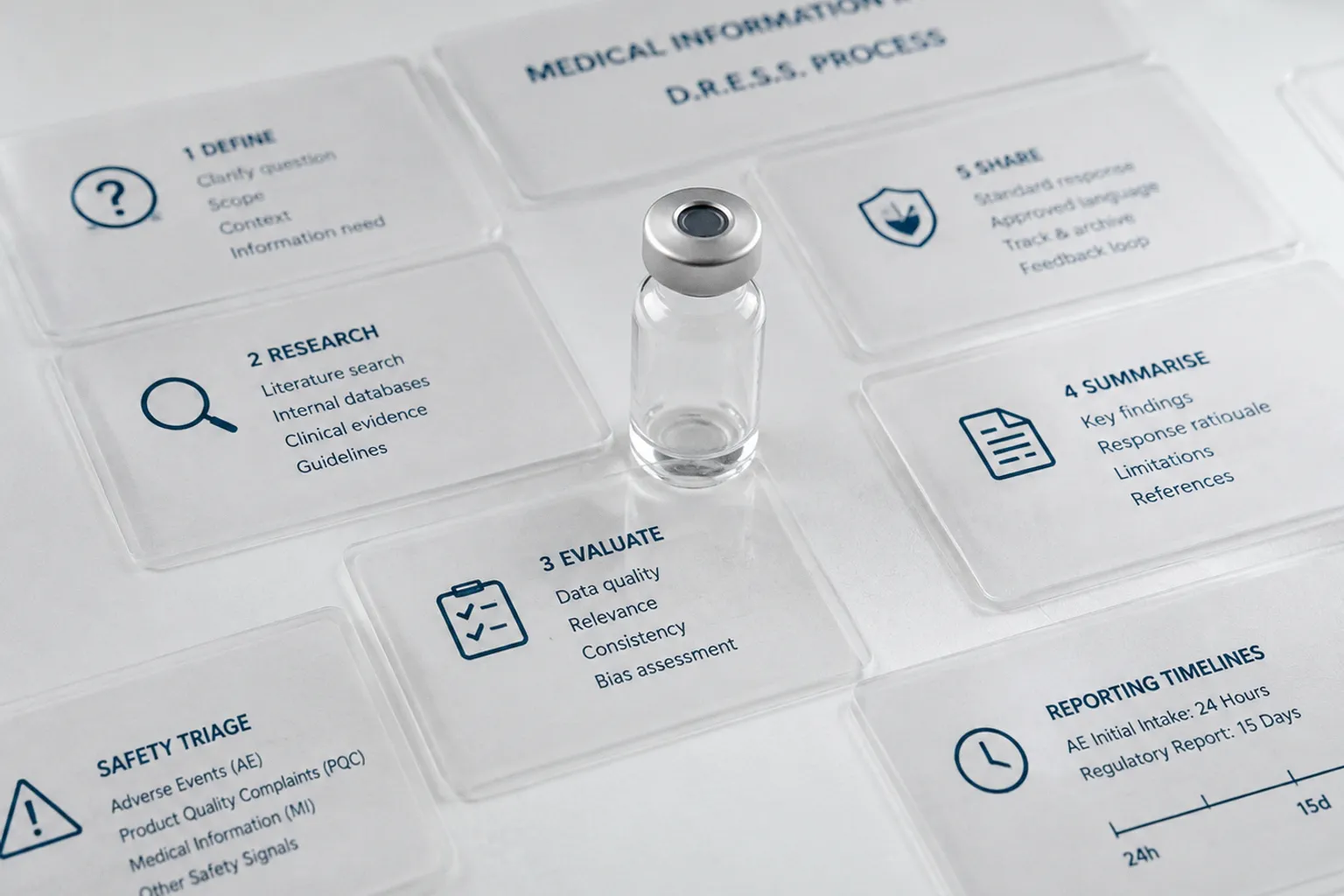
Once an inquiry has passed intake and triage, the scientific work begins. The DRESS methodology provides a five-step structure for resolving Medical Information questions:
- Define the question
- Research the topic
- Evaluate the evidence
- Synthesize a response
- Share the answer
The value of DRESS is not the acronym itself. The value is that it prevents the team from jumping directly from a vague request to a polished answer.
Define the question
The requester’s first wording may not represent the real information need. A question about dosing may actually concern a missed dose. A request for comparative efficacy may involve a treatment decision for a named patient. A question about an adverse reaction may also contain a product quality complaint.
The handler should clarify the scope without leading the requester toward a particular answer. The final question definition should state what information is being requested, the relevant population or context, and any limits on the response.
This is also the point at which you distinguish general information from clinical advice. If the requester wants a treatment decision for an individual patient, the response must remain within the Medical Information remit and direct the clinical decision back to the treating healthcare professional.
Research the topic
Research should be proportionate to the question and controlled by the organization’s evidence framework. Routine on-label inquiries may be answered using an approved Standard Response Document or Standard Response Letter. A non-standard inquiry may require a targeted search of prescribing information, clinical data, safety information, published literature, internal evidence, or other approved scientific sources.
The research record should show what was consulted and why. This is not bureaucratic overhead. It protects scientific consistency when the same issue appears again and allows a reviewer to determine whether the response reflects the available evidence at the time.
Evaluate the evidence
Evidence evaluation is where many teams lose discipline. A response can be technically accurate and still be misleading if it fails to distinguish study design, population, endpoint, comparator, or limitation.
The reviewer should assess:
- Whether the evidence directly answers the question.
- Whether the population matches the requester’s context.
- Whether the endpoint supports the proposed conclusion.
- Whether the data are descriptive, comparative, exploratory, or confirmatory.
- Whether relevant limitations or uncertainties must be stated.
- Whether safety information changes the interpretation.
- Whether the answer could be read as a recommendation beyond the approved context.
The Medical Information response is not a sales argument. It is a controlled scientific communication. That requires balance, clarity, and an explicit boundary around what the evidence does not establish.
Synthesize and share
Synthesis is not the same as copying source material into a letter. The response should answer the defined question in a readable sequence, using language appropriate to the requester. It should include enough context to avoid misinterpretation and avoid unsupported extrapolation.
Before sharing, the workflow should verify:
- The response addresses the actual question.
- The content matches the requester’s status and the request pathway.
- Any safety information has been routed correctly.
- Required medical, legal, regulatory, or cross-functional review is complete.
- The final version is the approved version.
- Dispatch and follow-up are documented.
This is where a medical information standard response letter workflow either demonstrates maturity or exposes control weakness. The answer must be scientifically sound, but it must also be traceable.
DRESS turns scientific inquiry resolution into a repeatable workflow. Without that structure, speed becomes improvisation and consistency becomes luck.
Standardized versus custom responses: build the right control for the right question
Standardization creates scalability. It does not eliminate judgment.
Standard Response Documents or Standard Response Letters are appropriate for recurring, predictable, on-label inquiries where the content has passed the organization’s required medical and legal review. They reduce unnecessary drafting, improve consistency across channels, and allow the team to respond efficiently to routine questions.
But an approved document is not a universal answer. The handler must confirm that the requester’s question matches the scope, population, product version, and approval context of the document. A near match can be more dangerous than an obvious mismatch because it creates false confidence.
Custom responses are required when the question is novel, complex, non-standard, scientifically unsettled, or outside the scope of available standard materials. They may also be necessary when the requester asks for interpretation across studies, a specific patient context, emerging safety information, or a question that intersects with regulatory sensitivity.
| Workflow element | Standard response | Custom scientific response |
|---|---|---|
| Typical use | Recurrent, on-label inquiry with approved content | Novel, complex, or non-standard inquiry |
| Scientific work | Confirm scope and current approval status | Research, evaluate, and synthesise evidence |
| Review burden | Use the required approved review pathway | Medical review, with additional functions as needed |
| Main control risk | Sending a document that does not actually answer the question | Inconsistent interpretation or unsupported extrapolation |
| Scalability | High when document governance is strong | Lower, but necessary for scientific complexity |
| Record requirement | Document the selected response and rationale | Retain sources, drafts, reviews, and final communication |
A document library also requires lifecycle governance. The organization should know which response letters are active, which are superseded, which markets they apply to, and what change triggered review. Product updates, label changes, safety signals, new evidence, and regulatory decisions can invalidate previously approved content.
The most common operational mistake is to measure the library by volume. A large library is not necessarily a capable library. It can become a search problem, with multiple near-duplicate documents and uncertain ownership. A smaller, clearly governed set of response materials is more useful than an archive that cannot be trusted.
Medical review should be designed, not negotiated case by case
Review pathways should distinguish routine approval from exceptional escalation. Otherwise, every inquiry becomes an individual negotiation between the writer and reviewer.
Define in advance:
- Which response types require medical review.
- Which content requires Legal or Regulatory review.
- When Pharmacovigilance or Quality must be consulted.
- Who can approve a new or materially changed standard response.
- How urgent safety-related content is handled.
- How version control is maintained.
- How disagreements are documented and resolved.
This is the governance layer of the Medical Information service. It is what converts individual expertise into organizational capability.
Pharmacovigilance integration: timelines, ownership, and audit trails
Medical Information is a safety-relevant intake point. That fact should shape the operating model from the beginning, not be added later as a compliance attachment.
A potential adverse event discovered during a Medical Information interaction must be handled under the organization’s pharmacovigilance procedures. The same applies to product quality complaints and medication errors. The inquiry may have started as a scientific question, but the presence of safety information changes the routing requirements.
Provided workflow requirements identify a standard initial intake window of 24 hours for captured adverse events and an expedited reporting deadline of 15 business days for serious adverse events to regulatory authorities. Your organization must operationalize those timelines through local procedures, system alerts, trained personnel, and clear ownership. A deadline written in a procedure but not supported by queue monitoring is not a reliable control.
The intake record should make it possible to answer:
- When was the information first received?
- When was a potential safety case recognised?
- Who performed the initial intake?
- When was the case transferred to Pharmacovigilance?
- What information was missing?
- What follow-up was attempted?
- What reporting action was taken?
- Which response was sent to the requester?
- Were the scientific response and safety case appropriately linked?
The audit trail should cover both the case and the communication. A safety report without the originating inquiry may lack context. A medical information record without the safety case reference may conceal a critical handoff.
Escalation is a design problem
Repeated late escalations are rarely caused only by inattentive employees. They usually indicate a flawed workflow. The trigger language may be unclear. The intake screen may hide the safety question. The system may lack a prominent escalation route. The contact centre may be measured on closure speed rather than correct classification. Field teams may not understand what information Medical Information needs.
A mature medical information service governance model examines the entire chain:
1. Signal recognition — can the frontline handler identify a potential event?
2. Case capture — are the essential details recorded consistently?
3. Routing — does the case reach the correct safety or quality function?
4. Acknowledgement — is ownership visible after handoff?
5. Follow-up — can missing information be pursued without losing the original context?
6. Closure — is the final status documented and reconciled with the inquiry?
7. Learning — are recurring failure points reviewed and corrected?
This is where quality monitoring should focus. Counting the number of inquiries answered tells you very little. More useful measures include intake completeness, correct safety escalation, response accuracy, review turnaround, use of current approved materials, repeat inquiry patterns, and root causes of delayed closure.
Making the workflow scalable across regions and channels
Scalability does not mean imposing one identical process on every market. It means defining a stable global control framework while allowing local requirements, languages, products, and reporting rules to be configured without breaking the core workflow.
Your operating model should separate what must remain consistent from what can be adapted.
The global layer may define:
- Minimum intake fields.
- Safety screening expectations.
- Core triage categories.
- Scientific response principles.
- Document governance.
- Audit-trail requirements.
- Training standards.
- Quality metrics.
The local layer may configure:
- Market-specific product information.
- Local reporting pathways.
- Language and translation requirements.
- Local approval status.
- Contact channels.
- Country-specific escalation contacts.
- Applicable response time commitments.
Technology should support this architecture, not dictate it. A sophisticated platform cannot repair unclear ownership or poor intake design. Conversely, a well-designed process can function effectively with modest technology if the controls are explicit and consistently applied.
Automation is most valuable where it reduces predictable administrative friction:
- Routing inquiries by product or market.
- Flagging missing mandatory fields.
- Triggering safety escalation alerts.
- Controlling document versions.
- Recording review status.
- Linking related interactions.
- Producing management dashboards.
- Identifying recurring questions that justify a new standard response.
Automation should not be used to produce unsupervised clinical recommendations or to bypass scientific and medical review. The more sensitive the question, the more important it is to preserve human accountability.
A strategic mandate for Medical Information leaders
If your Medical Information service is experiencing inconsistent responses, delayed escalations, or repeated rework, do not begin by asking the team to work harder. Diagnose the structure.
A practical improvement sequence is:
1. Map every intake channel. Include contact centres, email, web forms, field medical, medical science liaisons, congress interactions, and shared mailboxes.
2. Standardize the minimum data set. Make product, question, requester, safety content, timing, and escalation status visible in every record.
3. Install the five-part control model. Separate intake, triage, response, compliance, and reporting responsibilities.
4. Create a plain-language safety screen. Do not depend on pharmacovigilance vocabulary at the frontline.
5. Apply DRESS consistently. Define the question before researching and evaluate evidence before drafting.
6. Rationalize the response library. Remove duplicates, assign owners, and control effective dates and market applicability.
7. Formalize review routes. Make medical, legal, regulatory, quality, and safety escalation rules explicit.
8. Measure handoffs, not just closures. The critical performance indicators are often found between functions.
9. Test the audit trail. Select completed cases and reconstruct the full path from first contact to final response and safety disposition.
10. Use recurring inquiries as intelligence. Repeated questions can reveal educational needs, evidence gaps, label confusion, product quality patterns, or field communication problems.
The best Medical Information teams are not simply responsive. They are structurally dependable. They protect the boundary around unsolicited scientific communication, identify safety data at the point of contact, produce evidence-based answers, and make every handoff accountable.
That is the standard to operationalize: a workflow in which scientific quality, pharmacovigilance discipline, and service scalability reinforce one another rather than compete for attention.